What Is a Subsidiary? Meaning, Structure, and How It Works
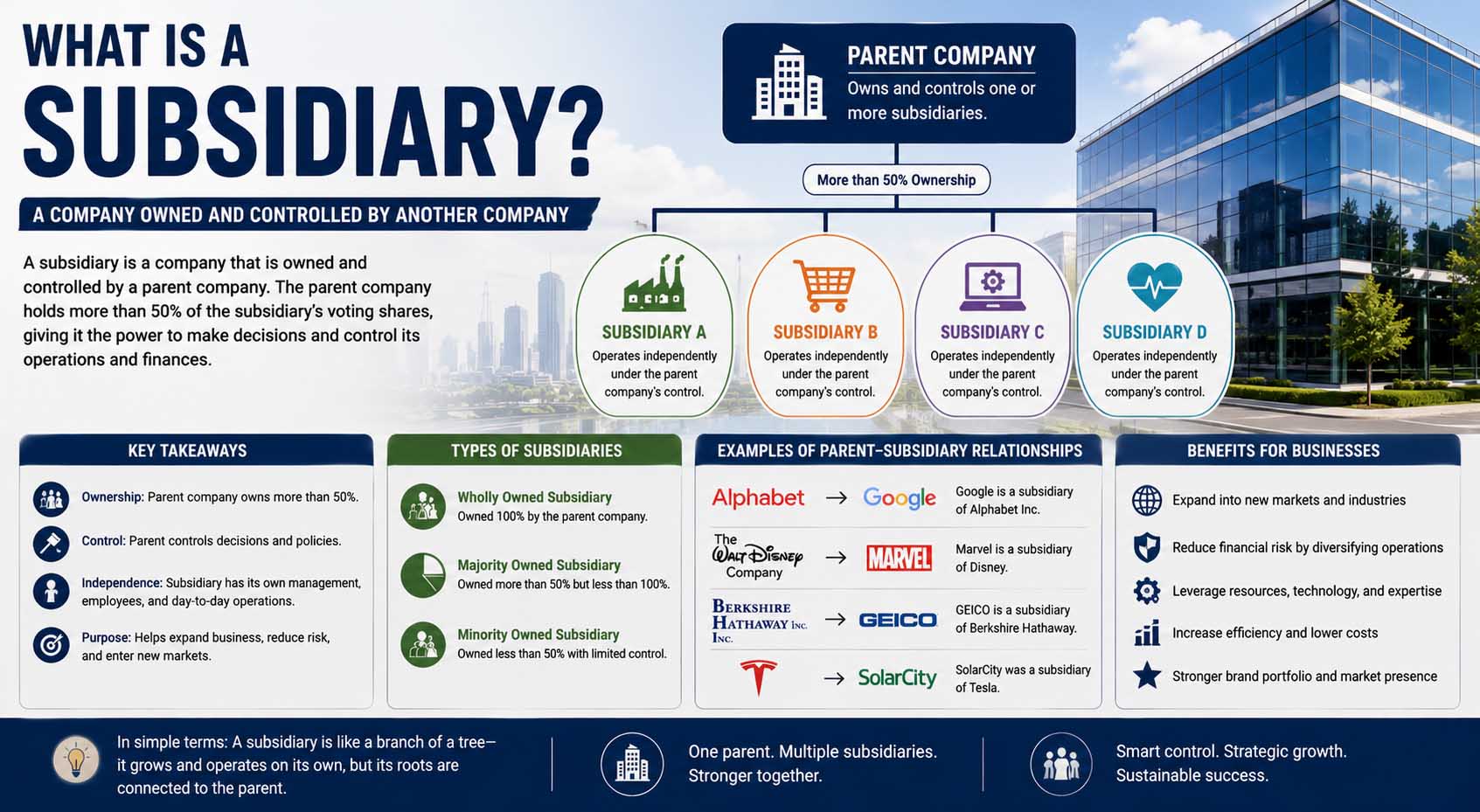
A growing business does not always put every operation under one legal entity. Instead, it may own separate companies for different brands, markets, or business activities. So, what is a subsidiary? A subsidiary is a company controlled by another company, usually called its parent company. Although the parent exercises control, the generally remains a separate legal entity with its own operations, obligations, and records.
Subsidiaries appear everywhere from small business groups to multinational corporations. For example, a parent company might own a software business, a logistics company, and a retail brand as separate subsidiaries.
However, ownership structures can become complicated. Therefore, understanding the relationship between a subsidiary, parent company, holding company, and business division is useful for entrepreneurs, employees, investors, and anyone studying corporate organization.
What Is a Subsidiary Company?
If you’re wondering what is a subsidiary company, think of it as a company that sits below another business in an ownership structure.
The company above it has enough ownership or other rights to control it. In many straightforward arrangements, control comes from owning more than half of the voting shares. However, the assessment of control can also depend on voting arrangements, contractual rights, governance, and applicable accounting or corporate rules.
Suppose Horizon Group owns 80% of a company called BrightTech.
BrightTech remains a separate company. However, because Horizon has a controlling interest, BrightTech is its subsidiary.
Depending on the structure, BrightTech could still have its own:
- Employees
- Management team
- Bank accounts
- Contracts
- Customers
- Assets
- Liabilities
- Offices
- Brand identity
- Accounting records
The parent may influence major decisions while allowing BrightTech’s managers to handle everyday operations.
What Is a Subsidiary of a Company?
The question what is a subsidiary of a company becomes easier to understand when you separate ownership from operations.
A subsidiary is controlled by another business, yet it can operate with a significant degree of independence.
For instance, imagine a large food company purchases a controlling stake in a popular beverage manufacturer. The beverage company may keep its original brand, products, employees, and customers. Behind the scenes, though, the parent can influence major strategic and governance decisions through its ownership.
This setup differs from an internal department. A marketing department, for example, normally exists inside the same legal entity as the rest of the company. A subsidiary, by contrast, is generally its own legal entity.
Businesses researching how to start a holding company often encounter subsidiaries because holding structures commonly involve one entity owning interests in one or more separate companies.
Parent Company vs. Subsidiary
The relationship is easier to visualize as a hierarchy:
Parent Company
↓
Subsidiary Company
The parent controls the subsidiary, while the subsidiary is the controlled company.
Here is a quick comparison:
| Feature | Parent Company | Subsidiary |
|---|---|---|
| Main relationship | Controls another company | Controlled by another company |
| Legal identity | Separate entity | Usually separate entity |
| Ownership role | Holds controlling interest | Shares or interests are held by parent |
| Management | May influence major decisions | May have its own managers |
| Operations | May or may not operate directly | Usually conducts business activities |
| Brand | May have its own brand | Can retain a separate brand |
A parent can own several subsidiaries at the same time. Likewise, a subsidiary can sometimes own another subsidiary, creating multiple levels within a corporate group.
What Is a Wholly Owned Subsidiary?
A wholly owned subsidiary is generally a subsidiary in which the parent owns 100% of the ownership interests.
For example, if Apex Corporation owns every share of Nova Manufacturing, Nova is a wholly owned of Apex.
Because there are no outside shareholders in the subsidiary, the parent has complete ownership of it. Still, the subsidiary can remain a legally separate entity.
That distinction matters.
Owning 100% of a company does not necessarily mean that the parent and become one legal business. Corporate formalities, contracts, financial records, regulatory obligations, and other requirements may still need to remain separate.
Meanwhile, a partially owned subsidiary has one or more other owners. For example, a parent could hold 75% while outside investors own the remaining 25%.
Why Do Companies Create Subsidiaries?
Businesses use subsidiaries for several practical reasons.
Entering a New Market
A company expanding into another country may establish a local subsidiary.
This arrangement can provide a distinct entity for local employees, customers, contracts, licenses, and operations. However, international structures introduce tax, regulatory, employment, and reporting issues that require local professional guidance.
Keeping Brands Separate
Suppose a corporation buys a successful clothing company.
Rather than replacing its established identity, the parent may operate the acquired business as a subsidiary. As a result, customers continue interacting with the familiar brand while the parent owns it behind the scenes.
Separating Different Operations
A business group might place manufacturing, property ownership, software development, and retail activities into different entities.
This approach can make organizational responsibilities easier to define. Still, creating multiple companies also increases administration.
Acquiring Established Businesses
When a company purchases another business, keeping the acquired organization as a may preserve employees, contracts, brand recognition, and existing processes.
As a result, management can decide gradually which activities should be integrated.
Subsidiary vs. Holding Company
A holding company and a subsidiary occupy different positions in a corporate structure.
A holding company primarily holds ownership interests in other companies or assets. A subsidiary, meanwhile, is a business controlled by a parent.
In a simple structure:
Holding Company
↓
Operating Subsidiary A
↓
Business activities
The holding company might also own Subsidiary B and Subsidiary C directly.
People researching Was Ist Eine Holding will recognize the same basic concept: a holding structure organizes ownership above one or more controlled businesses, although the precise legal, tax, and accounting treatment depends on jurisdiction.
Not every parent is a pure holding company, either. A parent company can conduct substantial operations itself while also owning subsidiaries.
Subsidiary vs. Branch vs. Division
These terms are sometimes confused, yet they describe different organizational relationships.
A subsidiary is generally a separate legal entity controlled by another company.
A branch is usually an extension or location of the same legal business rather than a separately incorporated company.
A division is normally an internal business unit. For example, a corporation could have consumer products and industrial products divisions without forming separate companies for either operation.
This distinction can affect contracts, accounting, taxation, liability, reporting, and regulatory requirements.
Therefore, businesses should choose structures based on their actual legal and operational needs rather than simply adopting terminology that sounds appropriate.
Advantages of Using Subsidiaries
Subsidiary structures can offer several strategic advantages.
Operational Flexibility
A subsidiary can focus on its own products, customers, or geographic market while the parent sets broader strategic goals.
Consequently, local management may retain specialized expertise without requiring the parent to control every routine decision.
Brand Independence
Different brands can remain separate even when they share common ownership.
This can be valuable after an acquisition because changing a well-established brand may reduce customer recognition.
Easier Performance Tracking
Separate financial records can make it easier for management to evaluate how individual businesses are performing.
However, group reporting can still become complex, especially when companies conduct transactions with one another.
Strategic Buying and Selling
A parent may acquire a business as a separate. Likewise, depending on the circumstances, it may later sell its ownership interest.
Keeping operations in distinct entities can sometimes make corporate transactions easier to organize.
Disadvantages and Risks of Subsidiary Structures
Subsidiaries also create costs and complexity.
Each entity may have separate filing, accounting, licensing, tax, governance, and compliance requirements. Therefore, a group containing many subsidiaries can require substantial administrative support.
Corporate structures also need clear management responsibilities.
If the parent interferes with every minor decision, subsidiary leaders may struggle to operate efficiently. On the other hand, too little oversight can create inconsistent standards or unmanaged risks.
Corporate entities can also have different advantages and limitations depending on how they are organized. Reviewing corporation advantages and disadvantages can help business owners understand why separate corporate entities may provide useful structural benefits while creating formal compliance obligations.
Most of all, forming a subsidiary does not automatically guarantee protection from every liability. Courts, regulators, lenders, contracts, guarantees, and specific laws can affect responsibility. Therefore, professional legal advice matters when liability separation is a major reason for creating the structure.
Choosing an Entity for a Subsidiary
The appropriate legal form depends on where the company operates and what the business needs.
In the United States, for example, a subsidiary may sometimes be organized as a corporation or limited liability company, subject to applicable ownership and tax rules.
An LLC can offer flexible management and liability features, which is why entrepreneurs often research the benefits of an llc when considering separate entities for different operations.
However, legal entity type and federal tax classification are separate questions in some situations.
For instance, business owners comparing the difference between llc and s corp should understand that an LLC is a legal entity created under state law, while S corporation status generally refers to a federal tax election available to qualifying entities.
Consequently, business owners should choose a structure with appropriate legal and tax guidance rather than relying only on a general online comparison
For public companies, investors can also use the U.S. Securities and Exchange Commission’s EDGAR company filings to review official disclosures that may describe subsidiaries, corporate ownership, and organizational structures.
How Subsidiaries Are Managed
There is no single management model for every corporate group.
Some parents use centralized management. In this model, the parent may control budgets, technology, human resources, procurement, and major strategic decisions.
Other groups use a decentralized approach.
Here, subsidiary managers have greater authority over pricing, hiring, marketing, products, and normal operations while the parent focuses on capital allocation and broad strategy.
Many organizations combine both approaches.
For example, cybersecurity policies and financial controls might be centralized, while local marketing and customer service remain under subsidiary management.
The best model depends on the size of the group, industry, regulatory environment, and degree of operational similarity between businesses.
What Is a Subsidiary Ledger?
The term subsidiary ledger sounds similar, but it refers to accounting rather than corporate ownership.
A subsidiary ledger is a detailed accounting record that supports a balance in a general ledger control account.
For example, a company’s accounts receivable general ledger account may show a total amount owed by customers. Meanwhile, the accounts receivable subsidiary ledger provides detailed balances for individual customers.
Other common subsidiary ledgers may track accounts payable, inventory, or fixed assets.
Therefore, a subsidiary ledger is not a company. The shared word “subsidiary” simply reflects a supporting or secondary relationship.
A Simple Subsidiary Example
Imagine a fictional company called Summit Business Group.
It owns:
- Summit Software LLC — develops business applications.
- Summit Logistics Inc. — provides delivery and warehousing.
If Summit Business Group controls each entity, those businesses can be subsidiaries of the group.
However, they do not necessarily operate identically.
The software company may have engineers and subscription customers, while the logistics business owns delivery equipment and employs drivers. Meanwhile, their management teams can focus on the distinct needs of their respective markets.
The parent can coordinate strategy across the group without requiring both businesses to become one operating entity.
Common Misunderstandings About Subsidiaries
One common mistake is assuming every company owned partly by another business is automatically a subsidiary.
A minority investment without control may instead receive different legal or accounting treatment. Therefore, ownership percentage alone does not always tell the full story.
Another misconception is that subsidiaries must use the parent’s name. They do not. A subsidiary can operate under a completely different brand.
Likewise, 100% ownership does not necessarily erase separate legal status. A wholly owned can still remain its own legal entity.
Finally, a subsidiary is not simply another office or department. That distinction is one of the most useful concepts for beginners to remember.
What Is a Subsidiary? FAQs
Does a Subsidiary Have Its Own CEO?
It can. Many subsidiaries have their own executives or management teams, although the parent may influence appointments and major strategic decisions.
Can a Subsidiary Own Another Company?
Yes. A subsidiary can sometimes own or control another subsidiary, creating several layers in a corporate group.
Does a Subsidiary Pay Its Own Taxes?
That depends on jurisdiction, entity type, ownership, tax elections, and group structure. Some groups may file consolidated or combined returns where permitted, while others have separate filing obligations.
Is a Wholly Owned Subsidiary Independent?
It can have separate legal status and day-to-day operations, but its parent owns 100% of it and therefore has ownership control.
Can a Small Business Have a Subsidiary?
Yes. Subsidiaries are not limited to multinational corporations. Smaller companies may use them when there is a legitimate legal, operational, investment, or strategic reason.
Is a Franchise a Subsidiary?
Not normally. An independently owned franchise business operates under a franchise agreement rather than being controlled through ownership by the franchisor. However, corporate-owned locations can involve different structures.
Practical Takeaways for Business Owners
Understanding what is a subsidiary starts with one basic relationship: one company controls another company that generally remains a separate legal entity.
From there, the structure can become as simple or complex as the business requires. A parent might own one subsidiary, several wholly owned companies, or a multi-level group containing businesses in different countries and industries.
For entrepreneurs, subsidiaries can support acquisitions, separate brands, new markets, and specialized operations. However, they also bring legal, accounting, tax, governance, and administrative responsibilities.
Before creating one, define exactly what the subsidiary is supposed to accomplish. Then, discuss the proposed structure with qualified legal and tax professionals who understand the relevant jurisdiction. A subsidiary works best when it solves a real business need rather than simply adding another company to an organizational chart